The Eating for Sustenance Cookbook
📖 ⋆ Foreword
Welcome to the Eating for Sustenance Cookbook. Please ask yourself why you unnecessarily stumbled upon this page when there are so many interesting things to do. This is a recipe blog from a lazy person who lost their zest for life long ago but still feels a lingering obligation to respect the opportunity of being alive. As such, cooking is essential. This cookbook may be amended and restated from time to time.
I have always been a self-proclaimed good cook (to the extent that a Chinese vegetarian can cook). I became a vegetarian during my undergraduate years. I graze (now) and photosynthesise (before moving to the UK), but in my freshman year I was still a carnivore. I remember making Coca-Cola chicken in the shared kitchen in my dorm building. The chicken was okay, but I had some leftover sauce that I did not want to waste, so I cooked it with leftover beef from my friend. Oh lord, it did not taste good. That remains the only kitchen disaster in the 27 glorious years I have lived so far.
The residential assistant saw me cooking and insisted on trying it despite my word of caution. She tried the beef and said it was good. Then came the 2016 Year of the Monkey celebration, when the RA invited every Chinese student to cook for our dorm social except me. Ehhh, why cannot people just be honest with me?
I cannot explain why I wanted to be a vegetarian. I woke up in my little dorm bed one day, the idea suddenly struck me, and I decided to go with it. I have never missed meat since. Long before that, however, I had already stopped eating fish.
I used to eat everything as a child. Then when I was nine, I went on a fishing trip with my dad and his friends. Not gonna lie, as a child I had a lot of useless talents. Although it was my first time fishing, I was just qualitatively better than my dad and all his friends. I caught the most fish and the biggest fish of the day, a giant carp. It was so big that it had to be placed in a bucket on its own, its body tumbling and its tail flapping angrily against the bucket through the entire ride home.
The place where we were fishing was a designated fishing spot. Most fish do not get to grow old there. I can almost hear the carp complaining: I’ve made it this far. How can it possibly end like this?
The carp was too big for a family of three, so my dad took the carp to my friend’s grandma’s place to process. I did not see her kill the carp, but I saw her packaging the finished product into several takeaway boxes. I stopped eating seafood after that.
People sometimes ask me why I am vegetarian. It is easy to answer this question in China because I can always say I am Buddhist. Once I gave this answer to a British friend and they asked, What is Buddhism? My brain went completely blank and I stopped bringing up Buddhism to people.
There are many Chinese women who are vegetarian and Buddhist. Among my mum’s friends, these tend to be women with plenty of free time and the luxury of having everyone accommodate them. I am not treated like a rich lady. People usually accommodate me by adding vegetables to meat dishes (although as I have aged people have become visibly more receptive) or going to fancy vegetarian places serving fake meat. I am not a fan, but it is acceptable. At regular Chinese restaurants, when someone is kind enough to inform the chefs of my dietary requirements, the disappointment on the staff’s faces is difficult to ignore, and I often wish they can just ignore me. When people do decide to accommodate someone of high status, however, they can go to great lengths.
My mum and her friends used to study under a Tibetan Buddhist guru who sometimes visited the east side of China to raise funds for his institute in Seda, Sichuan. His wealthy followers would often become competitive, trying to get him to sit in their cars so their cars could be blessed.
The guru followed the strictest Han Buddhist commandments despite being Tibetan. He did not eat strong spices such as garlic*. So whichever restaurant he went to, it took twice as long to serve food because certain pre-made ingredients, such as dumpling fillings, could not be used. Everyone was happy to starve and wait.
*There are mixed theories on why Chinese Buddhist monks are not allowed to eat strong spices. The most popular ones are: (1) spices make you horny; and (2) spices make you smell bad, which is inconvenient for monks who often live in communal dorms. I am largely indifferent to this, as I have always been too lazy to procure spices anyways.
I am no guru. My mum once went on a hunger strike against me, trying to get me to eat meat. She was unsuccessful.
Who would have thought Kun who refused to be a mummy’s girl would later become a corporate bitch. When I returned to China for my first full-time job, my team went to a team-building session at a very expensive Japanese all-you-can-eat restaurant. Everyone ordered sashimi. I had stir-fried udon. My team was very upset with me for wasting the team budget. While I was at that job, I ate at the office canteen every day. Since in a Chinese canteen vegetables are always considered an accessory, and I cannot wear an accessory alone, I reverted to eating meat. I became vegetarian again after moving to the UK.
The key principles for my cooking are: (i) use as few pans as possible; (ii) spend as little time as possible; and (iii) use as few seasonings as possible, although I do love curries sometimes.
It is eating for sustenance at its core.
Detailed instructions or measurements are not included in my recipes. Do people actually care about these? I don’t. I can never follow a full recipe on the internet and always try to simplify it.
I do have a few friends who follow recipes very carefully, and they are always “S” people in MBTI. I am INTJ, so here we go. Cooking and eating for sustenance is an art. It requires instinct. Each dish needs to be crafted with introspection and self-awarenes, executed with simplicity, guided by the clear goal of sustenance.
If you want precision, eating for sustenance is not for you. Although it is probably not for anyone.
🥪 ⋆ New Year Eve Egg Sandwich
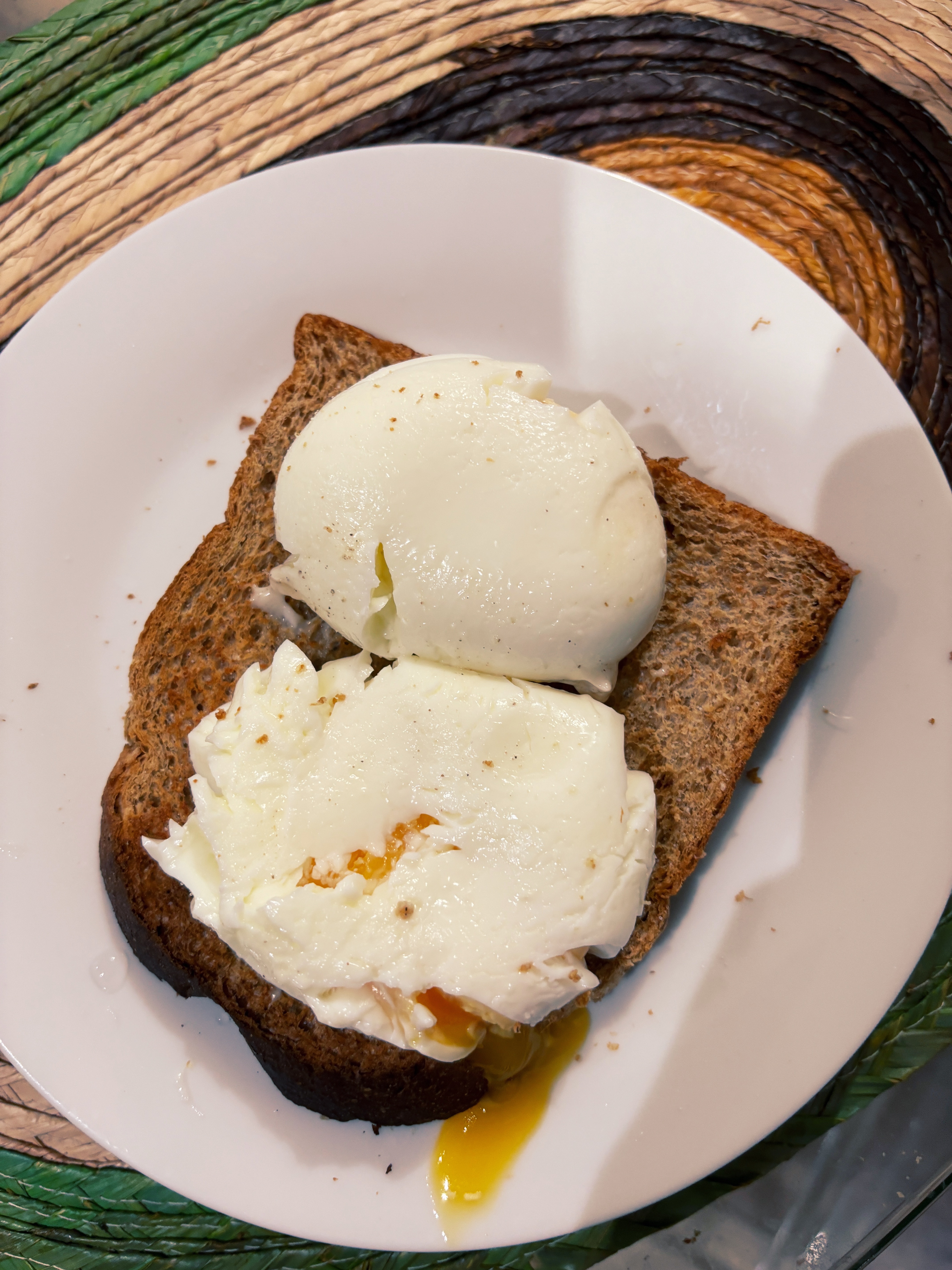 New Year Eve Egg Sandwich
What & How
- See image below. Add salt and pepper.
Why:
- It’s fast.
Named it New Year sandwich given I had it for the last two Chinese New Year eves.
I had never had an egg sandwich before moving to the UK, and I was inspired by one of the country's finest offerings: the meal deal. Egg mayo and egg watercress sandwiches are my only go-to meal deal options, and they inspired me to create this simpler version at home.
🍚 ⋆ Rice for One
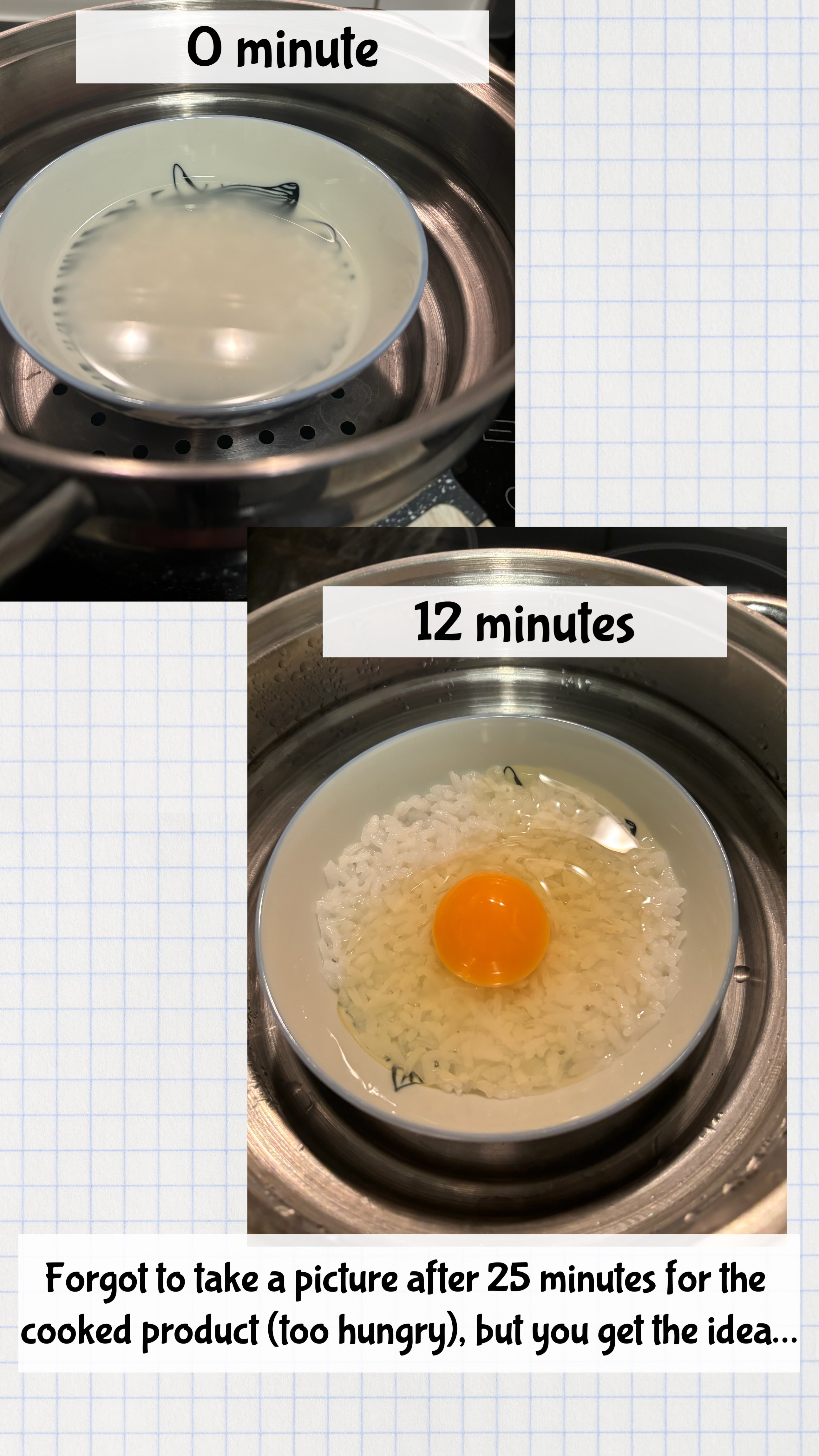 Rice for One
What:
- Rice, water, steamer.
How:
- Add rice and water in one bowl, preferably one with a wider bottom (aka not a bamboo-hat-shaped one). Water:rice 1:2. Steam for 22–25 minutes (one-person portion). Steaming for longer definitely makes the rice taste better, as an actual rice cooker takes around 40 minutes, but it’s just rice. You are eating for sustenance and do not need super high-quality rice.
- If you fancy an egg, add one around 10 minutes in (whenever your rice is no longer swimming in water). Total cooking time does not change.
You can put your bowl in a watered pan directly, removing the need for a steamer. However, your bowl will tap dance in the pan and damage any nonstick surface.
🍛 ⋆ Thai Curry (to go with Rice for One)
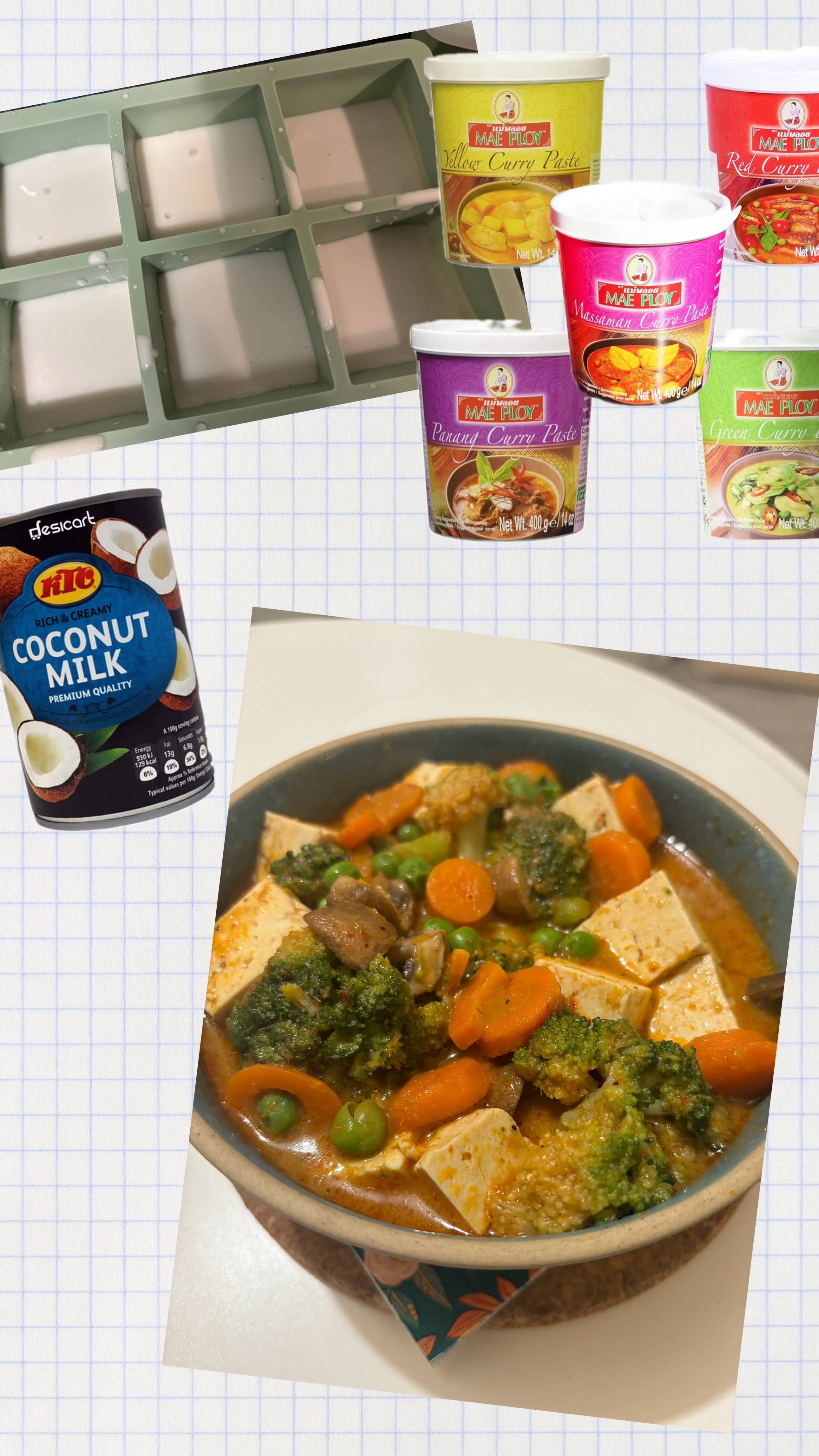 Thai Curry
What:
- Thai curry paste (any option you like, sometimes available in regular supermarkets, always available in Asian supermarkets)
- Choice of frozen or fresh veg and protein
- Coconut milk (not coconut water, available everywhere, not optional)
- Peanut butter (optional)
How:
- Add oil and stir-fry the curry paste (start with the size of a small egg, you can always add more later).
- Add coconut milk and bring to a boil with some water (no more water than coconut milk).
- Add veg/protein either during the stir-fry or during the boil, depending on how easily they cook.
- If you want the curry to taste a bit Vietnamese, add a spoonful of peanut butter. I tried peanutty curry at the Vietnamese place near LSE and loved it.
Coconut milk can be annoying. It usually requires a can opener and is not single-person friendly. However, you can freeze it in ice cubes. For me, each can of coconut milk makes six single-serving curry dishes.
Curry paste is sometimes not strictly vegetarian and may contain shrimp paste or fish sauce, but vegetarian options exist.
You can replace rice with Udon or other noodles.
I've recently developed feelings for frozen vegetables. They are good companions when you work long hours and cannot finish the fresh food in your fridge in time. My usual dinner is microwave baby potatoes and frozen veg, mixed with soy sauce and chilli oil. Mum and dad would be proud. Frozen veg mostly taste okay except broccoli, which can be soggy, but if you are eating for sustenance that should not be an issue.
🏮 ⋆ Xi’an Noodles
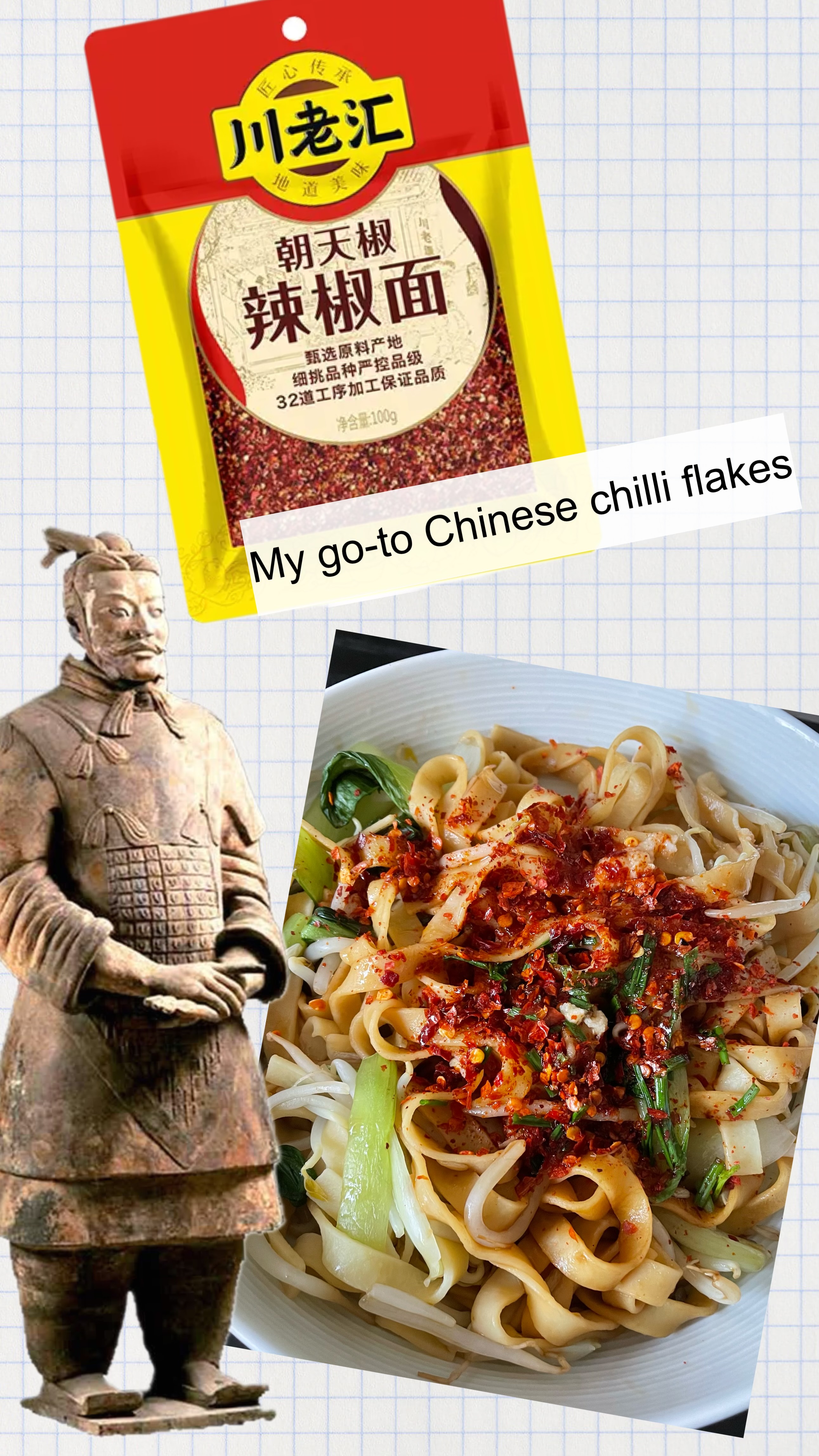 Xi’an Noodles
What:
- Noodles (any: handmade, dried, fresh pasta, Chinese dried noodles, etc. Fresh tagliatelle is actually very similar to Xi’an noodles)
- Soy sauce
- Vinegar (any: Chinese, balsamic, etc.)
- Chilli flakes (Chinese supermarkets; other chilli might work but I have never tried)
How:
- Boil veg and noodles, then drain.
- Add chilli flakes, soy sauce, and vinegar on top of the drained noodles. People often add garlic, but I don’t like the smell.
- Heat some oil (a few spoonfuls) and pour it over the condiments. You should hear a sizzling sound. That sound is key. If there is no sizzling sound, keep heating the oil.
Hand-pulled Xi'an noodles are not hard to make. I've tried at home but ended up with flour all over my hair...
🌶️ ⋆ Sweet Chilli BBQ Sauce
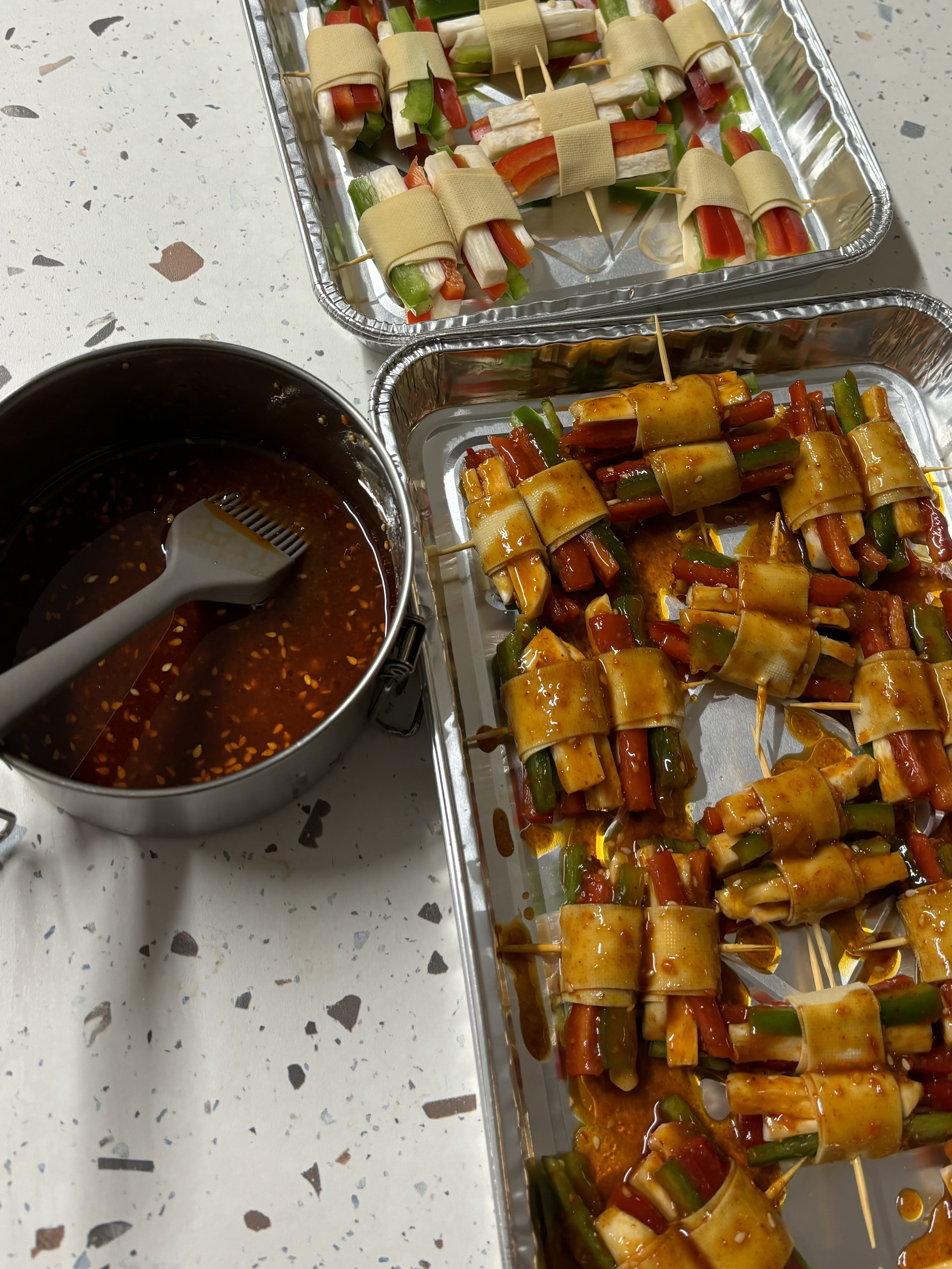 Sweet Chili BBQ Sauce
What:
- Same seasonings as the Xi’an noodles, plus
- Sesame (if you want the sauce to look cute)
- Cumin
- Apricot jam (for sweetness and stickiness)
- Salt
- Any spices you like, a good idea is to mix with off-the-shelf BBQ seasonings
How:
- Same method as the Xi’an noodles: pour hot oil onto the seasonings.
Replacing Chinese chilli with Korean gochujang and reducing vinegar gives a Korean taste. You can make Korean rice-cake stir-fry from it. Thinly sliced onion is a must.
😍 ⋆ Cheap Imitation Tianjin Crepe / Jianbing 低仿煎饼果子
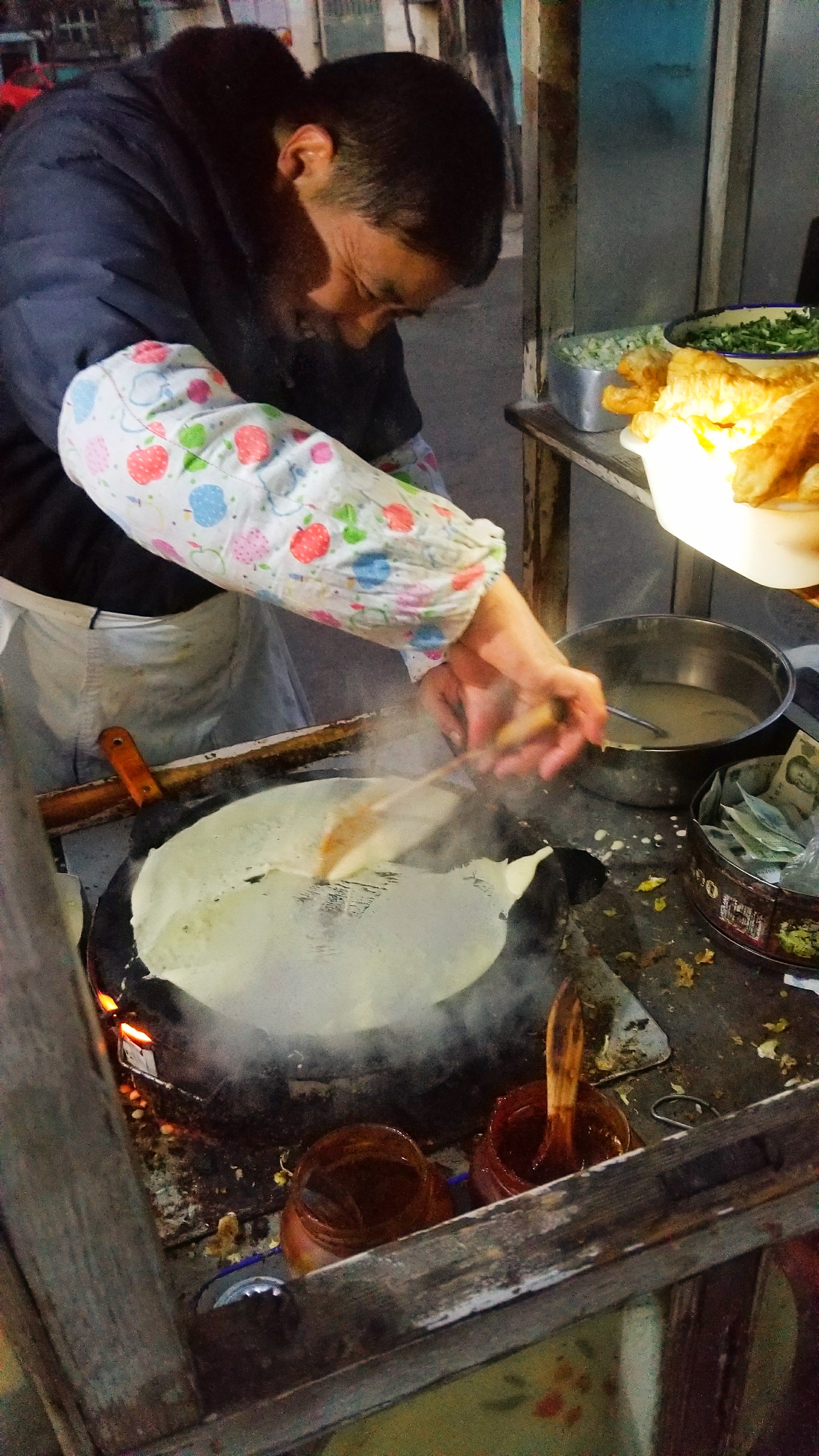 Jianbing Outside My Primary School; looks a bit messy; I know
What:
- Mung beans
- Soy milk machine or blender
- Flour
- Sweet bean sauce 甜面酱 (Chinese supermarket)
- Yorkshire pudding
- Egg
- Ingredients are a bit hard to get. This is more nostalgia cooking than eating-for-sustenance cooking.
- Tianjin Crepe/Jianbing originates in Tianjin but is widely available across China. Most are not authentic because Jianbing is supposed to be made with mung bean flour. You can see an example here:
- If there is one food I truly miss, it would be the Jianbing cart outside my primary school, run by an auntie-uncle couple. It is the taste of my childhood. As I was often late for school, they usually allowed me to jump the queue, except when their daughter wanted a Jianbing. Auntie usually covered the morning shift. During the countless times I queued there, I would sometimes see uncle come down from their apartment building and shout, “Daughter wants a Jianbing!” I have never actually seen the daughter.
- When I was studying or working abroad, I would visit the Jianbing cart once a year whenever I came home. Sometime after I started working, the daughter became a mother, and uncle and auntie, now grandpa and grandma, retired to take care of the child. They still live within a five-minute walk of my primary school and where my parents work, yet I haven’t run into them again, and probably never will. I have tried Jianbing in most major cities in China, but so far they have all been sub-par.
How:
- Make either:
- mung bean milk (using mung beans from Chinese supermarkets) with a soy milk machine; or
- mung bean paste (using a blender, though you probably need to soak the beans first).
- Mix cooled mung bean milk with regular flour, heat pan with oil and make a crepe. It is perfectly fine for your crepe to have holes and look like men’s underwear, because you will add an egg on top to cover uncovered areas.
- Once the crepe is no longer fluid, flip it to set completely. Add sweet bean sauce and microwaved Yorkshire pudding, which is similar to 油条 (Chinese fried dough sticks). Obviously 油条 is less challenging to make than mung bean mix, but frying at home is too much trouble unless you are cooking for many people.
The product in the picture includes only one Yorkshire pudding because I could not fold both in.
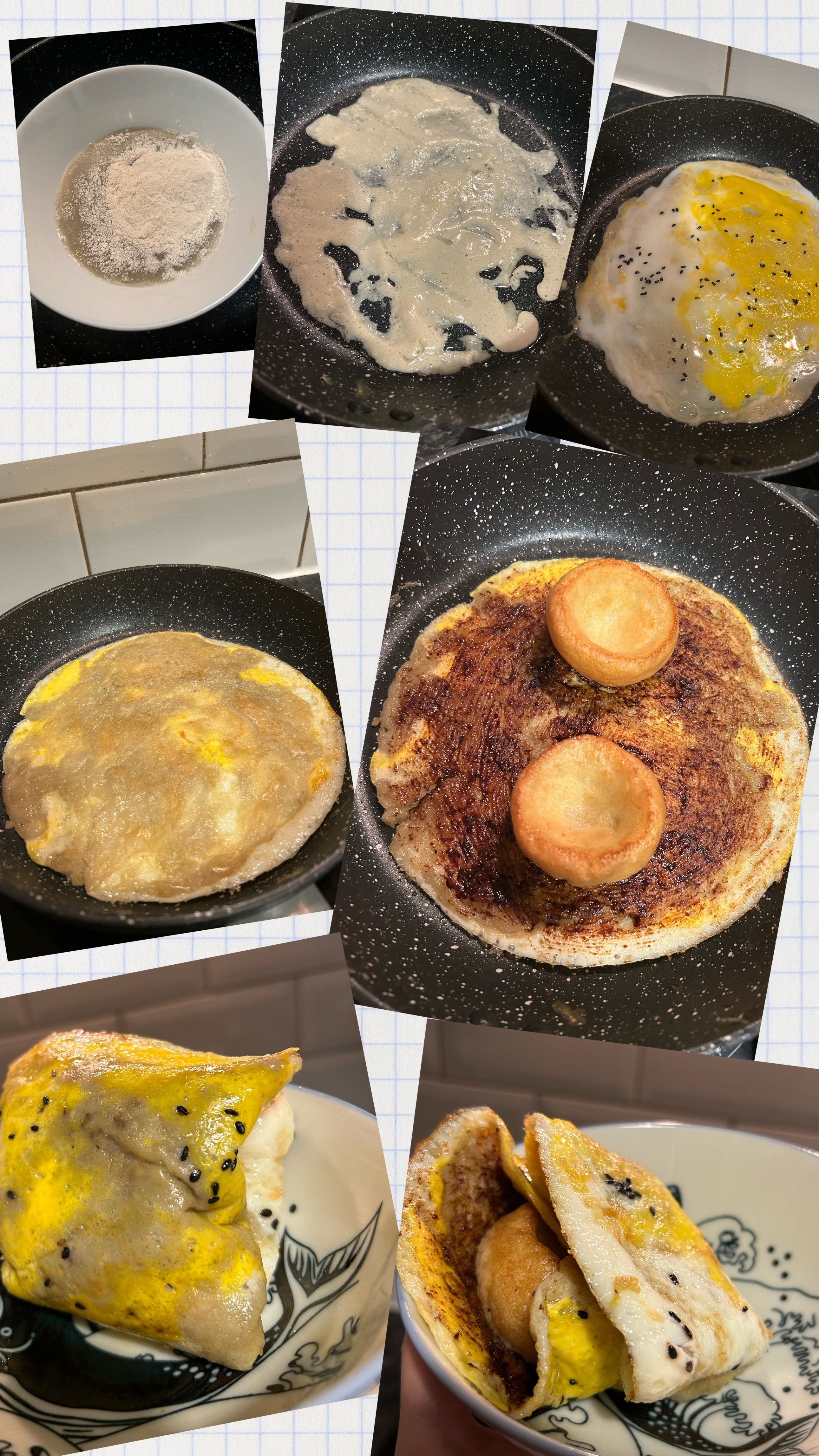 Cheap Imitation Jianbing
🥕 ⋆ Beijing Fried Daikon/Mooli and Carrot Balls 炸萝卜丸子
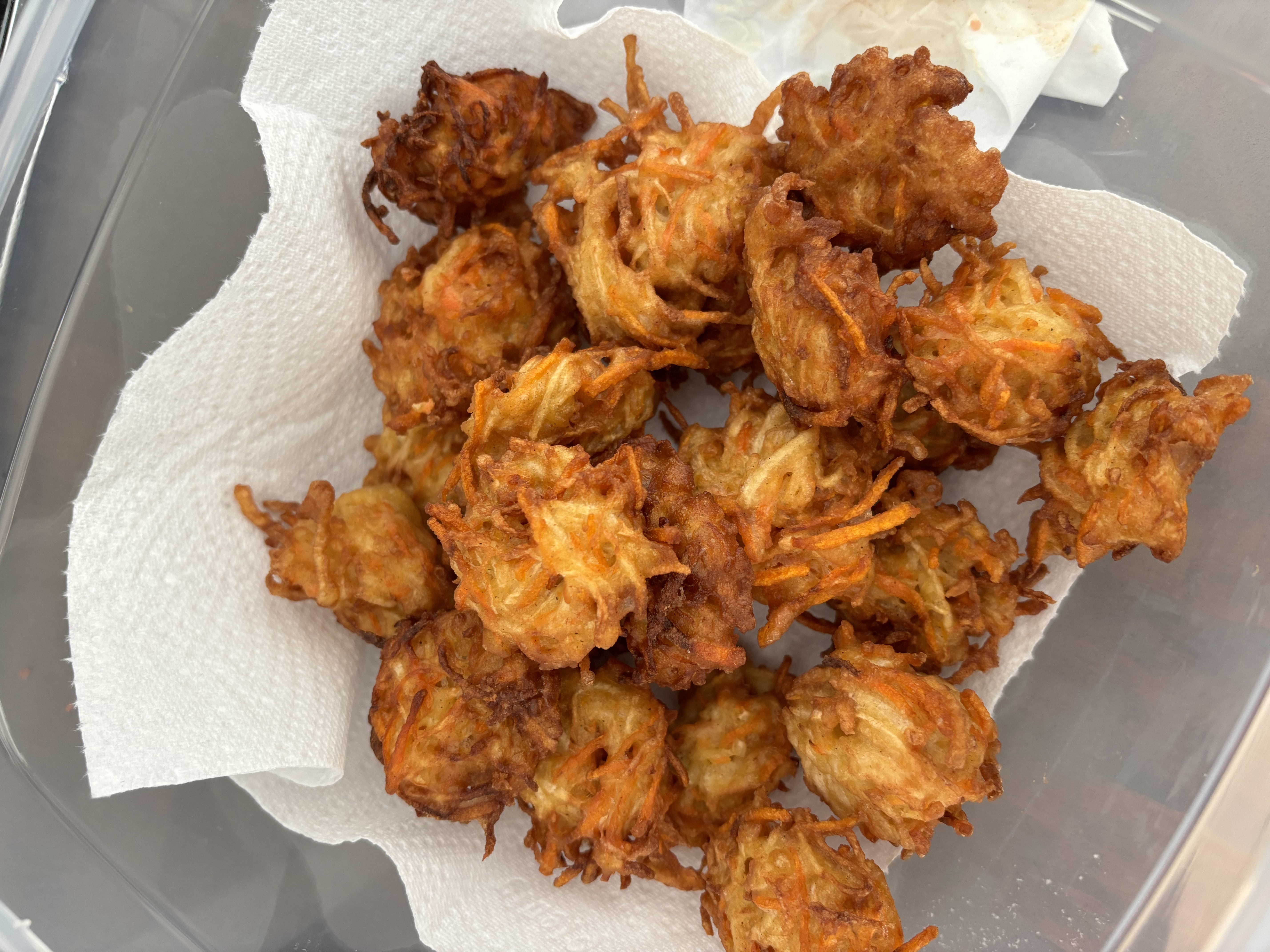 Beijing Fried Daikon/Mooli and Carrot Balls 炸萝卜丸子
What:
- Daikon
- Carrot
- Self-rising flour
How:
- Grate (or cut, if you are a pro) carrot and daikon into thin strips.
- Mix with salted self-rising flour dough, shape into balls (actually you can just use a spoon to scoop up the mixture and drop into frying oil directly), and deep fry. If you cannot make a ball with a spoon, your dough is too soft, should’ve added less water. You can still make a pancake.
- I forgot whether I added eggs, but if I did it would be no more than one and probably does not matter much.
Self-rising flour gives the finished product a fluffy texture. I do not know what Chinese chefs usually use, but whatever magic they have, self-rising flour works well enough.
This is a Beijing classic. The authentic version is more complicated, but when I served this to a friend they said it tasted exactly like their childhood. Unfortunately it is time-consuming to prepare thin strips and not practical to deep fry for one person. Better enjoyed with friends. Might experiment with an air fryer someday.
🍅 ⋆ Fakeshuka
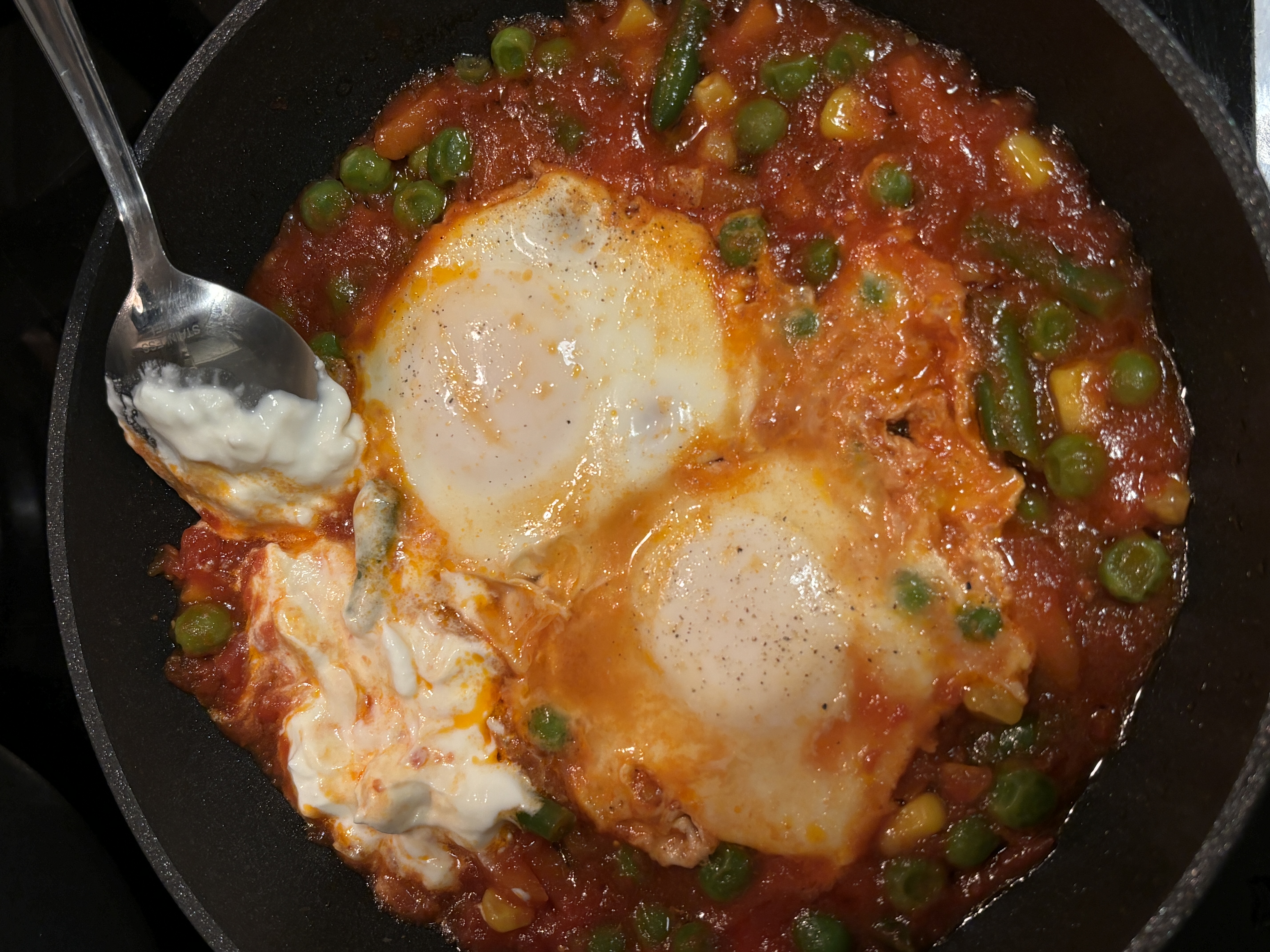 Fakeshuka
What:
- Canned tomatoes (finely chopped)
- Frozen veg
- Eggs
How:
- Boil veg with canned tomato. Add eggs and cook covered. Add salt and pepper.
- I added Greek yoghurt in the picture above but it is unnecessary.
🔥 ⋆ Kimchi Fried Rice
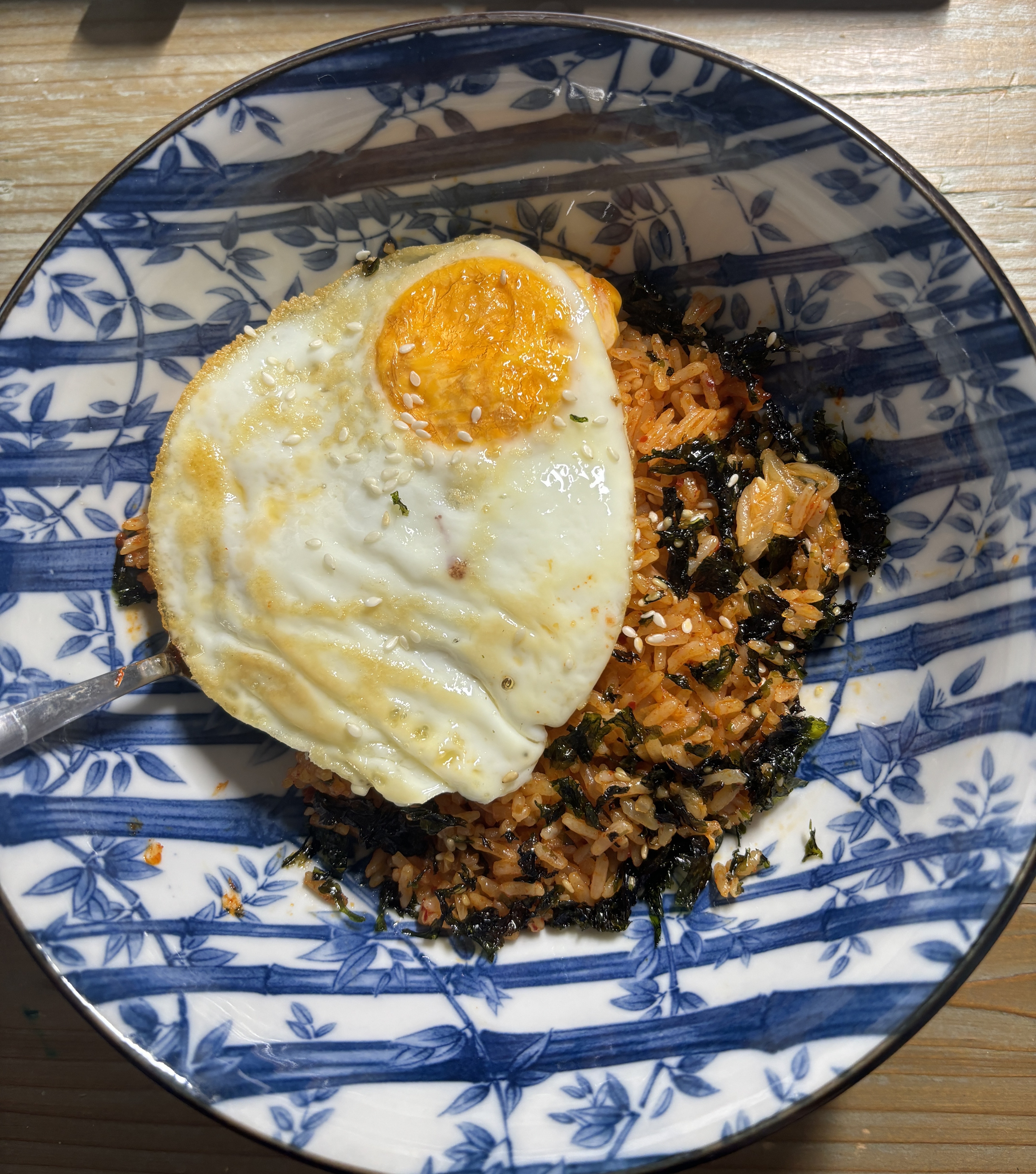 Kimchi Fried Rice
What:
- Rice for One
- Kimchi
- Gochujang
- Soy sauce
- Seaweed flakes
How:
- Nothing worth explaining. Just stir-fry the rice with the ingredients above.
- Seaweed flakes should be added at the end, not during the stir-fry.
Do not stir-fry with gochujang only. It will be too dry and too spicy. Mixing gochujang with honey might taste great, though I have never tried.